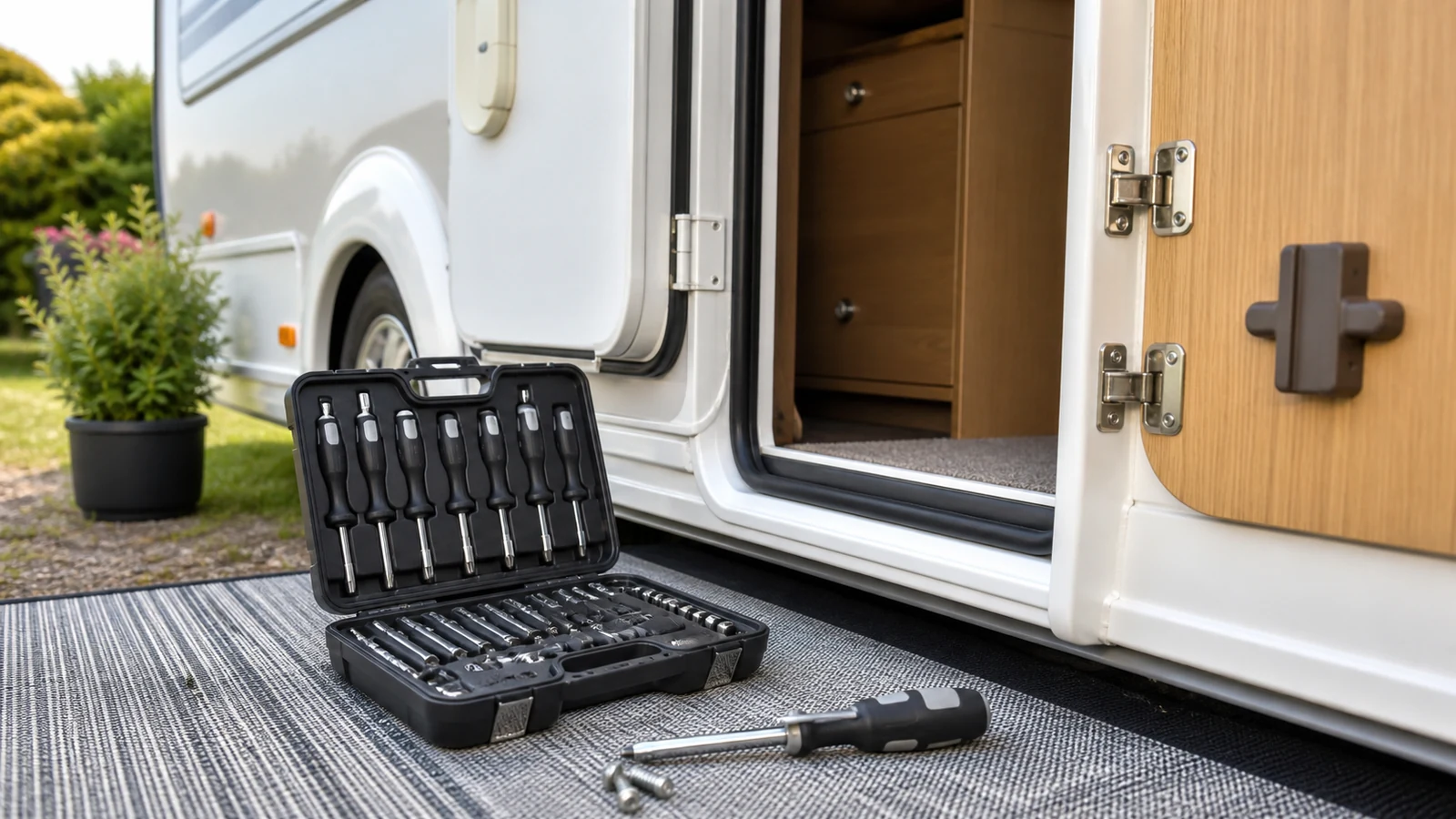
Caravan Screwdriver Set Hard Case Uk
A caravan screwdriver set with a hard case is useful because season-start jobs are small, scattered and awkward: hinges, catches, battery covers, loose trim, cabinet screws, awning brackets and the odd fastener in a locker. The hard case matters because you can see what is missing before you leave home.
Practical Caravan lists screwdriver sets among touring toolkit essentials in its caravan toolkit advice. That does not mean a screwdriver set is the whole toolkit. It means it is one of the items you will reach for often, especially during the first weekend after storage.
Season-start checklist
- Open the case and check every main handle, bit rail and precision bit is present.
- Tighten loose interior catches, cupboard hinges and removable fittings gently.
- Check exterior locker screws only where they are accessible and clearly mechanical.
- Keep a separate small pouch for tape, cable ties, torch, gloves and a pencil.
- Dry the case before storing it after a wet weekend.
- Add a small moisture absorber if the kit lives in a boot or shed.
- Remove any rusty bit early rather than letting it mark the rest of the case.
Why a hard case beats a loose bag
A loose bag is fine until the T20 bit drops into the boot liner, the small Phillips driver lives in the house, and the one hex key you need stayed in last year’s awning box. A blow-moulded or fixed-position case gives you a pre-trip inspection. Empty slot means missing tool. That is valuable when the nearest shop is not nearby.
The case also protects the caravan interior. Tools with defined slots are less likely to scrape furniture, leave oily marks or become a noisy pile under a dinette seat. The trade-off is space: if storage is extremely tight, a smaller roll may be better.
Rust and boot storage
No ordinary screwdriver set should be treated as waterproof. If the case has been in a damp shed, open it at home, wipe condensation and let the tools air dry. Do not store wet tools in a closed case. If the case stays in the car boot, avoid placing it against wet ground sheets or chemical bottles.
Electrical safety still matters around caravans and sheds. Electrical Safety First warns in its extension lead safety advice against overloading and daisy chaining extension leads, and London Fire Brigade notes in its home electrical leads guidance that cable reels should be unwound to reduce overheating risk. Those are use-and-stop rules, not screwdriver jobs.
What to add beyond screwdrivers
For touring, add a torch, gloves, adjustable spanner, pliers, tyre-pressure gauge, duct tape, cable ties and any specialist keys your caravan requires. A screwdriver case solves fasteners. It does not replace tyre kit, gas safety equipment, water-system spares or electrical hookup knowledge.
Where the Sorako case fits
The Sorako 118-piece hard-case set is relevant if you want one organised household-and-caravan case with mixed bits, precision drivers and a magnetiser/demagnetiser. It is not the best fit if you want a tiny ultralight roll for backpacking-style minimalism or if your caravan toolkit already has premium dedicated drivers.
Stop conditions
Stop and book a qualified repair for gas work, mains hookup faults, burnt plugs, repeatedly tripping electrics, damp in electrical enclosures, brake or chassis issues, structural water ingress or any fastener whose failure would affect towing safety. A screwdriver set is for checks and minor mechanical fixes, not critical systems.
A 20-minute pre-trip routine
Do the screwdriver check at home, not at the pitch. Open every locker, cupboard and removable panel you normally touch. Gently test the fasteners that worked loose last season. Check the table mount, bed hardware, shower-room catches, battery compartment cover and any accessory bracket you fitted yourself. The goal is not to tighten every screw in the caravan. The goal is to find obvious looseness while you still have light, time and a dry floor.
Then check the case itself. If a bit is rusty, replace it. If a handle is missing, solve that before the trip. If the case has been stored in a shed, let it air indoors overnight. Tools that travel damp become unpleasant quickly, and rust on one bit can mark nearby pieces. A small cloth inside the case is useful, but do not leave it wet.
When a smaller kit is better
A full hard case is not automatically the answer. If payload and storage are tight, choose a smaller roll with the exact drivers your caravan uses and keep the larger home kit in the garage. If you tour close to home and rarely repair anything on site, a basic screwdriver, pliers and torch may be enough. The hard-case set earns its keep when you travel farther, maintain outbuildings too, or want one case that covers home and caravan without repacking.
What the kit cannot diagnose
A screwdriver can tighten a catch, but it cannot tell you why a socket is hot, why a cable reel trips, why damp has appeared behind a panel or whether a gas appliance is safe. Treat those findings as inspection results, not invitations. The useful habit is noticing early and booking the right repair before the season is disrupted.
When this check is not enough
Do not use a household screwdriver-set article as permission to do electrical, gas, structural, landlord-responsibility, caravan mains or other regulated repair work.
When to stop and call someone qualified
Stop and call maintenance, a landlord, a qualified electrician or another competent professional when a job involves live electrics, gas, structural fixings, damaged tools, unsafe access or tenancy restrictions.
Direct answer and decision sections
Answered through the opening, useful element, negative-fit and stop-condition sections.
Direct answer and decision sections
Answered through the opening, useful element, negative-fit and stop-condition sections.
Direct answer and decision sections
Answered through the opening, useful element, negative-fit and stop-condition sections.
Direct answer and decision sections
Answered through the opening, useful element, negative-fit and stop-condition sections.
Direct answer and decision sections
Answered through the opening, useful element, negative-fit and stop-condition sections.
Direct answer and decision sections
Answered through the opening, useful element, negative-fit and stop-condition sections.