Student Tool Kit for University UK: What Is Useful, Safe and Small Enough for Halls
A student tool kit for university in the UK should be small, tidy and limited to low-risk jobs: assembling flat-pack furniture, tightening a loose chair screw, adjusting a desk hinge and dealing with tiny screws that vanish into carpet. It should not turn a student into the person who tackles sockets, wiring, appliances supplied by accommodation or anything the tenancy says must be reported.
The useful decision is simple: pack a compact kit if the student will live with self-assembly furniture, shared-house furniture or frequent move-outs. Skip it if they are in fully managed halls with strict maintenance rules and no private furniture to assemble. University move-in guidance from Southampton and Manchester shows how crowded and storage-conscious arrival can be, so the right kit is one that earns its space.
What a student can usually solve
The sensible jobs are mechanical and reversible. Think loose wardrobe handle, wobbly chair, bed slat bracket, desk leg, battery compartment, glasses screw, bike-light bracket or flat-pack cam lock. None of these changes the building. None requires opening a socket. None should leave a mark that has to be explained at check-out.
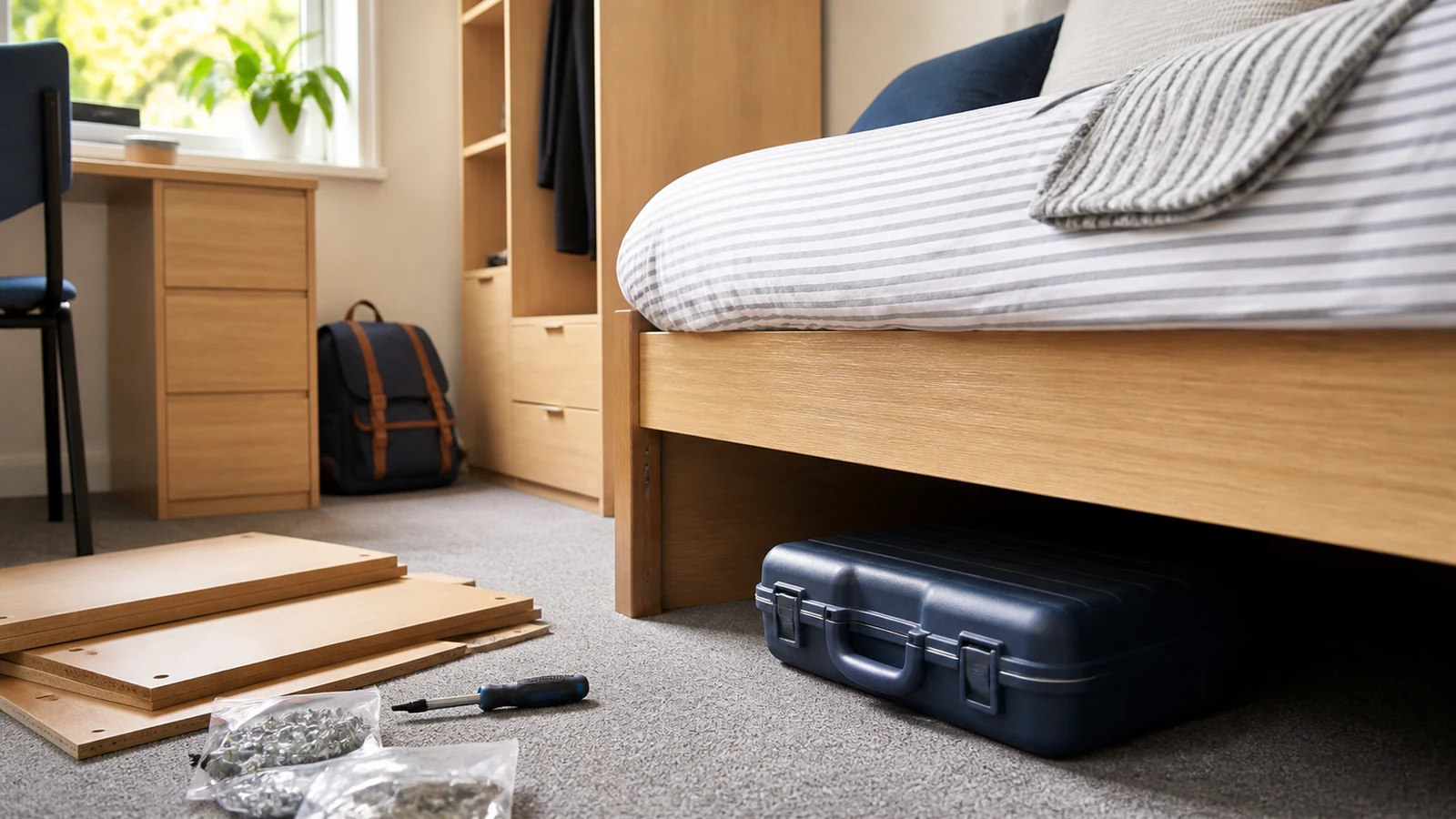
A screwdriver-led set is useful because student problems often happen at poor times: a shelf screw backs out on Sunday night, a second-hand desk arrives with mixed fasteners, or a wardrobe door rubs before a lecture week starts. A hard case matters more than it sounds. In a small room, loose bits become communal property quickly; fixed positions make missing pieces obvious before term ends.
University packing checklist
- One mixed screwdriver handle or set with Phillips, Pozi, flat and hex coverage.
- A small precision driver or bit range for glasses, battery covers and laptop-access panels where permitted.
- A magnetiser or magnetic tip for dropped screws, used away from sensitive electronics when that matters.
- A compact case that can slide under a bed or sit on top of a wardrobe.
- A written rule: do not open plugs, sockets, light fittings or accommodation appliances.
- A photo-before-photo-after habit for any shared-house furniture adjustment.
What not to touch
Electrical Safety First tells tenants not to carry out their own electrical repairs and to raise electrical problems with the landlord or accommodation provider; its tenant electrical safety guidance is the boundary line for a student kit. That means flickering lights, scorch marks, loose sockets, tripping breakers, buzzing plugs, failed heaters and damaged appliance cables are not screwdriver moments.
This is also where parents should be careful. A voltage tester or insulated driver can be useful in a household kit, but it is not a licence for a fresher to investigate live circuits in halls. The student should know what those tools are and know that they are for competent users in permitted settings.
Is a larger hard-case set worth the space?
It is worth it when the student is moving into private halls, a shared house or a flat where they will assemble furniture and keep the kit after graduation. It is less convincing for a tiny catered room where all furniture is supplied and maintenance staff respond quickly. In that case, a mini driver and hex key set may be enough.
If the conditions fit, the Sorako 118-piece set can sit as a conditional next step because the verified detail page shows a hard case, 118-piece coverage, magnetiser/demagnetiser, precision bits, 100-250V tester and 1000V insulated drivers. The practical reason to choose that size is continuity: the same case can follow the student from halls to a first rental, rather than becoming a one-term gadget.
Stop and report instead
Stop when the issue belongs to the building, carries heat or electrical risk, affects supplied appliances, needs drilling, changes locks, involves water near electrics, or could affect another tenant. Report it in writing, keep photos and use the accommodation repair route. A tool kit should reduce small frustrations, not shift safety responsibility onto an inexperienced student.
How to hand the kit over
If this is a parent buying for a student, do not hand it over as a dare to become the house repair person. Put a simple note in the case: use it for your own furniture, flat-pack parts, loose screws and battery covers; report anything fixed to the room, powered from the wall or supplied by accommodation. That small social rule matters in shared housing because useful tools attract borrowing. The student should be comfortable saying no when the job is outside their room, outside their competence or likely to create blame later.
For storage, choose one home for the case on day one. Under-bed storage works if the room is dry and the case is not buried beneath laundry. A wardrobe top works if the student can reach it safely. Before leaving halls for summer, open the case, check the obvious gaps and take a quick photo. That habit turns the kit into a portable household asset rather than another thing lost between rooms.
When this check is not enough
Do not use a household screwdriver-set article as permission to do electrical, gas, structural, landlord-responsibility, caravan mains or other regulated repair work.
When to stop and call someone qualified
Stop and call maintenance, a landlord, a qualified electrician or another competent professional when a job involves live electrics, gas, structural fixings, damaged tools, unsafe access or tenancy restrictions.
Direct answer and decision sections
Answered through the opening, useful element, negative-fit and stop-condition sections.
Direct answer and decision sections
Answered through the opening, useful element, negative-fit and stop-condition sections.
Direct answer and decision sections
Answered through the opening, useful element, negative-fit and stop-condition sections.
Direct answer and decision sections
Answered through the opening, useful element, negative-fit and stop-condition sections.
Direct answer and decision sections
Answered through the opening, useful element, negative-fit and stop-condition sections.
Direct answer and decision sections
Answered through the opening, useful element, negative-fit and stop-condition sections.