Voltage Tester Before Light Switch Uk
A voltage tester before light-switch work is a safety check, not permission to do electrical work. In the UK, the real decision is whether you are competent, whether the job is allowed in your property, and whether the work falls into an area where Building Control or a registered electrician should be involved.
The HSE says in its electricity FAQ that people can do their own electrical work if competent, while more complex tasks may not be within many people’s grasp. Bath & North East Somerset’s Part P guidance explains that small jobs such as replacing socket outlets or light switches do not normally require notification, but work must still be safe and other work may need Building Control or a competent person.
Decision table
| Situation | Decision | Reason |
|---|---|---|
| You are unsure how the circuit is wired | Call an electrician | Testing alone does not create competence. |
| The property is rented | Report first | Electrical work may be landlord responsibility or restricted by tenancy. |
| There are scorch marks, heat, buzzing or repeated trips | Stop immediately | These are danger signs, not DIY prompts. |
| You are doing permitted minor work and understand safe isolation | Proceed only within competence | Use appropriate tools, follow manufacturer instructions and verify before touching. |
| The job adds a circuit or involves a special location | Use Building Control or a registered electrician | Part P routes may apply. |
What a simple tester can and cannot do
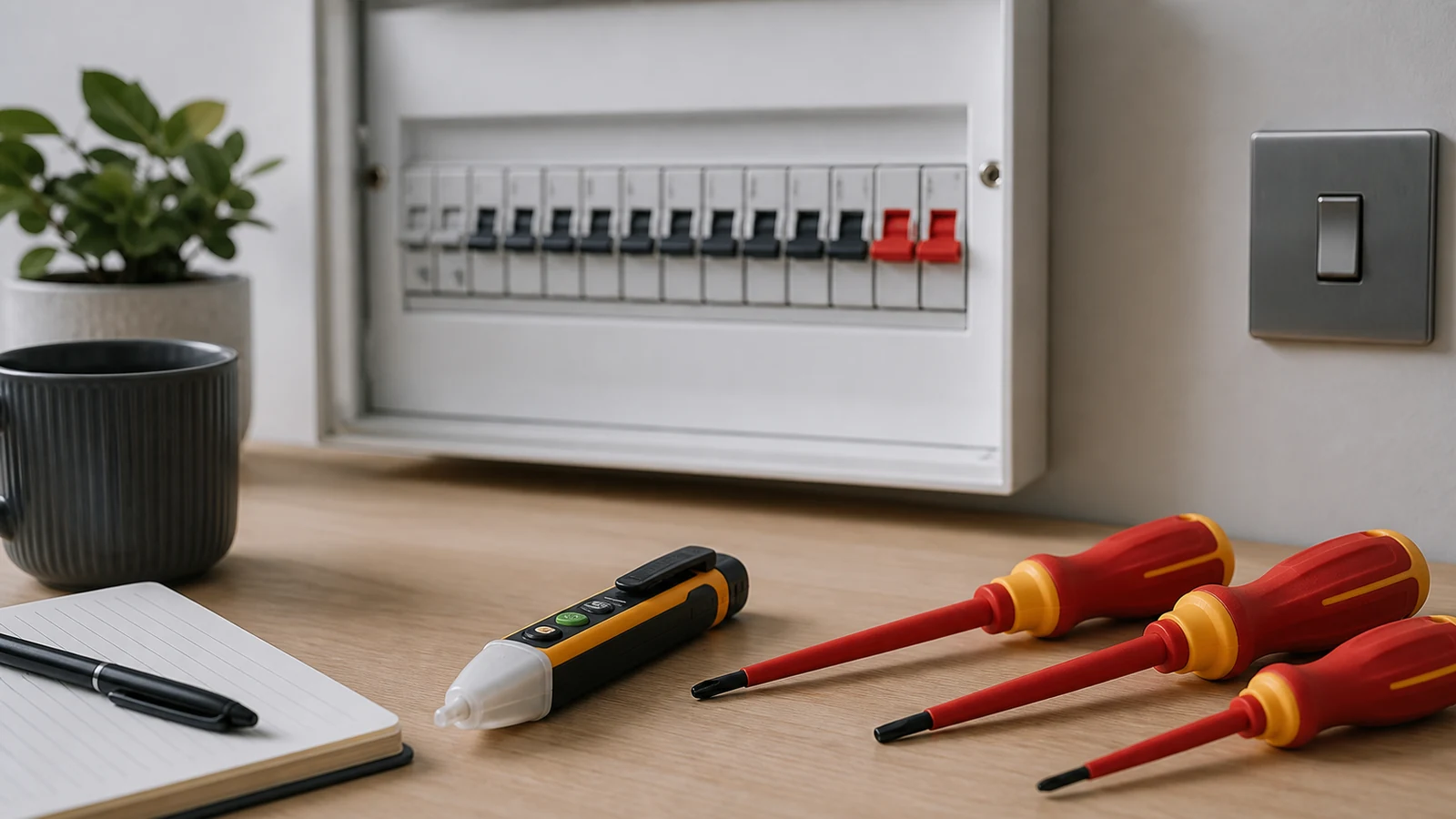
A 100-250V tester can help indicate the presence of AC voltage in the range it is designed for. It cannot prove every conductor is safe in every condition, cannot inspect the installation, cannot confirm the work complies with BS 7671, and cannot replace training. Insulated screwdrivers are a protective layer, not a licence to touch live parts.
Electrical Safety First’s extension lead guidance and London Fire Brigade’s cables, fuses and leads advice are useful reminders that domestic electrical risk often starts with overheating, overloading and damaged equipment. If you see heat damage, smell hot plastic, hear crackling or find frayed cable, the right action is to unplug if safe, stop and get qualified help.
Where a household kit fits
A household kit with insulated drivers and a voltage tester fits the planning stage for competent users handling permitted minor tasks. It also helps with non-electrical household work. It does not make renters responsible for fixed wiring, and it does not make a nervous beginner competent by ownership alone.
The Sorako detail route can be a conditional next step if you need one organised case that includes insulated screwdrivers, a tester and ordinary drivers for the rest of the home. The condition is important: choose it for appropriate low-risk work and preparation, not for live work or complex installation.
Who should not proceed
Do not proceed if you cannot identify the circuit, cannot isolate it, do not understand the wiring, are working in a bathroom or other special location, are in a rental without permission, or feel pressured by cost to attempt a job you would otherwise avoid. Saving a call-out fee is not a sound reason to override uncertainty.
Stop conditions
Stop for scorch marks, melted plastic, buzzing, burning smells, damp, exposed copper, repeated breaker trips, old or altered wiring, aluminium-looking conductors, no RCD protection where expected, or any result from the tester that you cannot explain. At that point the next tool is a qualified electrician, not a different screwdriver.
The real sequence is decision first, tool second
Many searches start with the tester because the tester feels like the missing object. In practice, the missing step is often a decision. Are you allowed to work on this property? Do you understand the circuit? Is the job only a like-for-like minor replacement, or are you changing wiring, adding a circuit or working near a special location? If those answers are unclear, buying a tester does not clear the uncertainty.
Competent people still use testers and insulated tools, but they use them inside a broader method: identify, isolate, verify, work, inspect and test. This article deliberately does not give a live-work recipe because the reader who needs a recipe for live work should not be doing it. For a cautious householder, that is not a failure. It is the point at which the safest and cheapest outcome may be paying for qualified help before damage is done.
Common trade-offs
A separate, higher-grade tester may be the better choice if electrical work is a regular and competent activity. A household kit with a simple tester is more plausible when electrical work is rare and most use will be ordinary screwdriver jobs. Insulated drivers are also useful around de-energised electrical accessories, but they should never be used as emotional reassurance to touch something you have not proved and do not understand.
Reader check before proceeding
If you cannot explain what will be isolated, how it will be verified and what will be restored, stop. If someone else depends on the circuit, tell them before isolation. If the switch controls more than one light, has two-way switching or contains unfamiliar conductors, stop. The right stopping point is before the faceplate is loose and the wires are no longer where you found them.
When this check is not enough
Do not use a household screwdriver-set article as permission to do electrical, gas, structural, landlord-responsibility, caravan mains or other regulated repair work.
When to stop and call someone qualified
Stop and call maintenance, a landlord, a qualified electrician or another competent professional when a job involves live electrics, gas, structural fixings, damaged tools, unsafe access or tenancy restrictions.
Direct answer and decision sections
Answered through the opening, useful element, negative-fit and stop-condition sections.
Direct answer and decision sections
Answered through the opening, useful element, negative-fit and stop-condition sections.
Direct answer and decision sections
Answered through the opening, useful element, negative-fit and stop-condition sections.
Direct answer and decision sections
Answered through the opening, useful element, negative-fit and stop-condition sections.
Direct answer and decision sections
Answered through the opening, useful element, negative-fit and stop-condition sections.
Direct answer and decision sections
Answered through the opening, useful element, negative-fit and stop-condition sections.